Showing posts with label thesis. Show all posts

Wednesday, May 27, 2009

Gyrfalcon Sketch

I apologize for not putting up more recent progress shots of the Griffon Vulture and Lanner Falcon, but they're already finished! Since I will be handing in my thesis tomorrow, I will thus be able to start posting the finished paintings here.

But for now, I'm working on my very last thesis painting, which is the Gyrfalcon as used in European falconry.


In medieval Europe, which bird you were allowed to fly was dependent on your social status. Emperors could fly eagles, whereas peasants were allowed tiny sparrowhawks. In the social ranking of falconry, the gyrfalcon was a noble bird reserved for kings. It is the largest of the falcons, and its plumage can range from gray barring to a striking, nearly pure white. Quite fitting as the bird of kings.

Saturday, May 23, 2009

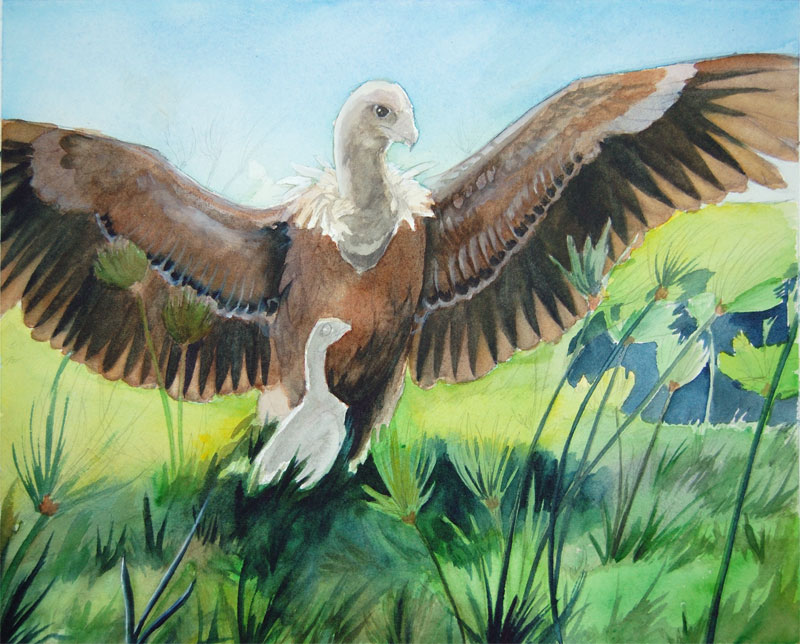
Griffon Vulture - Thesis Progress 1

Here is the first progress shot of the griffon vulture. As mentioned before, I am working quickly since I have this and two other paintings to finish within the week!


(Click for a larger version)

After looking at my previous illustrations, I realized all my lighting was shining right on the figure. This is the first I've done where I've experimented with backlighting. I think it creates a more interesting overall tone.

And the papyrus is giving me quite a bit of trouble. I think I'm going to have to break out the white gouache for this, but I think I can make it work.

Griffon Vulture Sketch

Thesis painting #8 will be the griffon vulture. In Egypt, this bird was the symbol of the goddess Nekhbet. Its head was used on the Upper Crown and its wings were a common decoration for the headdresses of royalty.


It was believed that when the griffon vulture turned its back to the southeast, that it would become fertilized. For this reason among others, it was considered a symbol of fertility.

In this painting, I wanted to show the vulture with its back to the southeast, with the sun streaming through its feathers. All around it are papyrus, a plant that grew on the Nile River.

Thursday, May 21, 2009

Bald Eagle - Thesis Progress 2

I'm about 75% done with the bald eagle thesis painting. I'm looking forward to painting that salmon! Fish are another subject I haven't had much experience with.


I love the Pacific Northwest. It's such a beautiful area.

Wednesday, May 20, 2009

Bald Eagle - Thesis Progress 1

The first progress of the bald eagle painting. I am working quickly because I need to have this and three others due in less than two weeks!


Bald eagle feathers are so beautiful and fun to paint. There is an interesting variation between reddish brown to nearly blue.

Tuesday, May 19, 2009

Bald Eagle - Thesis Sketch

Here is the sketch for thesis painting #7, which is the bald eagle. In the Northwest Coast of the United States, the image of the bald eagle was carved on poles, masks, and other items by native tribes. Since fish was a staple food of the people of the coast, they respected the eagle's ability to catch fish.

Here I show the bald eagle overlooking the coast with a salmon, an important fish of the region. Although bald eagles are not one of my favorite raptors (too often portrayed in art, often painfully kitschy), they are quite beautiful. In my painting, it will be perched on a western white pine, a common tree of the area.


The next paintings will be (though perhaps not in this order):

Gyrfalcon in European Falconry
Lanner Falcon as the God Horus
Griffin Vulture as the Goddess Nekhbet

Saturday, May 9, 2009

Peregrine Falcon - Homestretch!

I'm close to finishing the peregrine falcon thesis painting, so here is a progress shot so far. I've never really painted ducks before, so this proved to be an excellent excuse to study mallard plumage and try my hand at painting one. They're such lovely birds with such interesting plumage!


And a detail of the peregrine and duck:


I will have my thesis done by May 30th, so on that date, I will start to post the finished thesis paintings here.

Peregrine Falcon Thesis Painting Progress 2

Apologies for the lack of updates lately, however for the past week I've been concentrating on the writing portion of my thesis so that I would have a first draft done in time for editing. With that sent off, I've continued work on the painting of the peregrine falcon as used in falconry in the United States.

I am well aware that the peregrine is used worldwide in falconry, and not only in the United States. However, the purpose of this painting is not to exclude any region, but rather to focus on falconry in a specific area of the world, and I chose a bird that I feel represents a widely-used longwing species in the U.S.

It's only fair to point out the efforts of falconers and a variety of societies in the United States for peregrine falcon reintroduction after the widespread damage done by the pesticide DDT in the mid-20th century. The Peregrine Fund, which was started in 1970, was one of the foremost organizations in the United States to rebuild peregrine populations nationwide. To this day it remains an active force in raptor conservation. Other organizations which focus on raptor conservation include the North American Falconer's Association and a number of individual rehabilitation and education centers.

According to Candace Savage in her book Peregrine Falcons, the peregrine falcon population in the west coast region of the United States went from over 1,400 pairs in the 1940s to just over 100 pairs in the mid-1970s (an in-detail graph of worldwide populations exists on page 54, in case you have the book). In the late 1980s, the population on the west coast rose to just over 400 pairs. Today, the population of the peregrine falcon is doing well, thanks to the banning of DDT and these conservation efforts.

That said, here is the painting in progress:


And a detail of the falcon so far:


There peregrine falcon is also known as the 'duck hawk,' for what should be an apparent reason. When choosing a duck species, I wanted to show mallards since that is one of the most well-recognized duck species in the United States. While I know the jesses probably wouldn't be flying so wildly as that, I wanted to put a bit of movement behind the stiff, angular falcon to compliment the curving ducks.

The markings of peregrines are so beautiful, and while challenging to paint, it's rewarding when it starts to come out right.

UPDATE May 9, 2009 2:48 AM Here's a bit more progress:


Detail of the falcon:

Tuesday, April 28, 2009

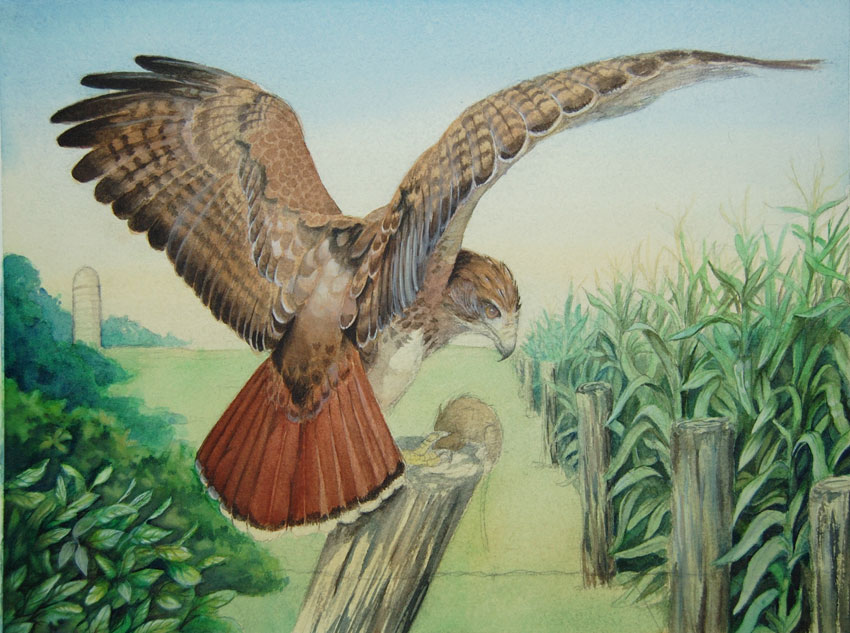
Red-tailed hawk progress 3

This is probably the last progress shot before I finish the painting. Here's a bit more detail on the hawk and the greenery. I always have trouble using green in bushes and trees without making it look flat and too monochromatic.


I've used a lot less white gouache on this than with the previous painting (the saker falcon painting), and I'm happy - I prefer the transparency of watercolor to opaque pigment.

Sunday, April 26, 2009

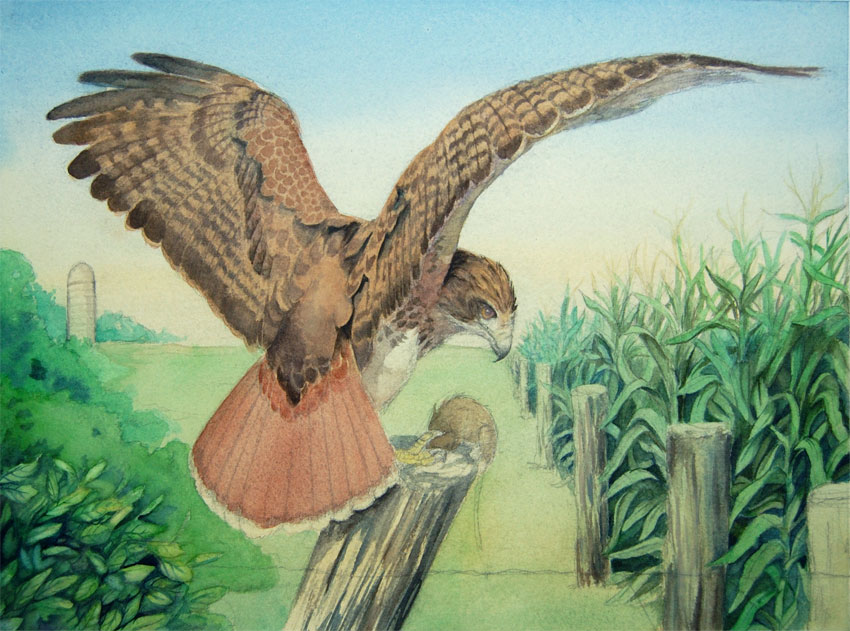
Red-tailed hawk progress 2

Another progress shot of the red-tailed hawk thesis painting. As before, I got carried away and forgot to take a progress shot, so it's much farther along for a 'second progress shot' than I'd planned!


The corn was surprisingly fun to paint. In addition to exploring each bird's plumage with watercolor, I'm also learning about landscapes and plants through each of these paintings. I've never painted corn before, and now I found a reason to!

For the sky, the detail-obsessed part of me is going, it's too simple! You need to add clouds! It needs to have more color! More more more!. Yet another, more (dare I say it) sophisticated part of me is saying, the sky is fine! Look at morning skies in real life. Often they are cloudless and simple. I think I shall keep the sky as it is. I think with all the detail in the hawk and plants, there needs to be some simplicity in the background.

I also wondered if I've been relying too heavily on the white gouache, so for this painting, you'll notice that there's no gouache in it yet. I think I will use it for the white bases of the feathers on the back, and perhaps for some detail on the leaves.

Tuesday, April 21, 2009

Double Feature - Peregrine and Red-Tail Progress

Now that the end of the quarter is within view, it's time to really get things rolling towards completion of the thesis. So far, I have four out of ten paintings done, and a good deal of writing down for the written portion.

Oddly enough, I work better (and faster) if I'm working on two paintings rather than just one. Aside from practical purposes (working on the second painting while a watercolor wash dries on the first, for example), I find working on two different pieces keeps my mind sharp and discourages wandering off to become caught up in distractions (such as sitting mindlessly in front of the computer).

Here is the graphite progress on the peregrine falcon painting. The blue tint is the initial wash.


I will admit - I'm making the peregrine painting extra special because it's my favorite of the birds. Aside from my shameless bias, I wanted to show the action that I feel the peregrine represents, both in the wild and in falconry. Part of my inspiration was renewed when I spoke with Stephen Hein, artist and director at The Center for Wildlife Education and the Lamar Q Ball, Jr. Raptor Center at Georgia Southern University in Statesboro, Georgia during a recent visit. He described a scene I've read about many times but never heard spoken by a falconer - he told about how he waited for his falcon to stoop, so high in the air, he couldn't see her. Then, that sound - the sound often described as 'tearing canvas' in the books - and she shot down into view in pursuit. Hearing of such an experience made my heart race again with newfound inspiration.

When I think of falcons I think streamlined, sharp, pointed. The shape of the stoop, even of the moment right as the bird is about to strike her prey, is sharp and angled. The peregrine is designed perfectly for speed, and in this painting, I wanted to show that, in contrast with the rounded, confused ducks.

The second painting is going to explore at the red-tailed hawk, and its passive role in human culture as 'vermin control.' Like the barn owl, red-tailed hawks actually benefit farmers by hunting the rodents that damage crops. Unfortunately, throughout history, this widespread hawk has been the victim of shooting, from farmers who incorrectly see them as 'chicken hawks.' In fact, the hawks that are most likely to take a shot at poultry are the accipiters - more specifically, the two larger species, the Coopers Hawk and the Northern Goshawk. Buteos like the red-tailed hawk are primarily rodent hunters.


I'm looking forward to working on all those beautiful feathers on the back, wings, and tail!

Saturday, April 4, 2009

Peregrine Falcon Study

I just couldn't wait anymore; I had to paint a peregrine!


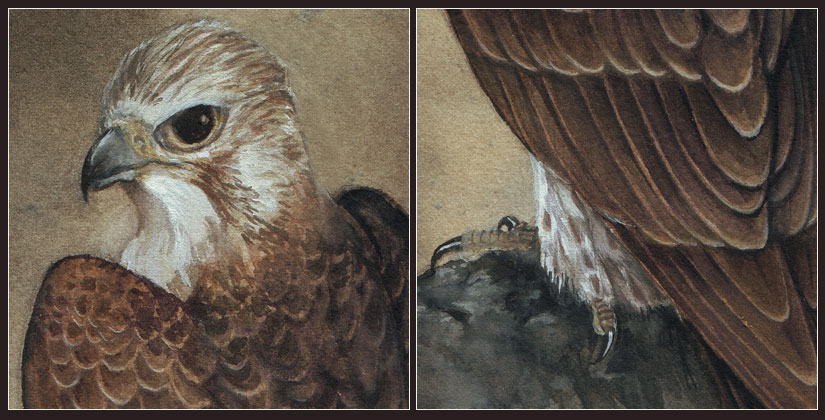
This was an study for plumage and form, and also it ended up being a study for rock doves, too. I love pigeons. They're so beautiful and so fun to paint! This is watercolor and white gouache on watercolor paper, 8X10 inches.

The saker falcon painting is done, and I'll be sure to post it up here once the thesis is complete. Now it's time to set up the show!

Tuesday, March 31, 2009

Saker Falcon Painting Progress 3

This is probably the last progress shot before I finish the painting. One a painting reaches this stage, I generally work on it steadily until I finish.


I'm having a lot of fun with the hood. The silver adornment is especially challenging, since I get to experiment with a reflective, shiny surface.

Friday, March 27, 2009

Saker Falcon Painting Progress

Now that I've finished with the harpy eagle, it's onto the saker falcon. I hope the experience gained from the study will help me with the plumage and form. Already I feel more confident with the forms of my falcons. It's amazing what you learn by staring at photo after photo of falcons! You begin to discover things about feather patterns, plumage, even little bits of personality that you didn't see before.


I knew essentially what I wanted to do for this painting, but the composition was giving me trouble. My professor, Rick Lovell, helped me and his suggestions helped me get to the composition I have now. At first I was hesitant to put a bird in with a hood, but then I realized this is as much about the humans in falconry as it is about the birds, and hoods, jesses, and perches are important to show the details of falconry.

Here is a quick photo of the first washes. I will be using a similar technique as I did in the study, with watercolor washes covering the entire piece to give everything a unifying tone (in this case, yellow ochre) with white gouache to give parts opacity.


Things look a bit warped and wonky since I have to photograph the progress shots instead of scanning. This piece is 11X14 stretched on a 16X20 board, which is next to impossible to scan. The sky will be that piercing blue you get in the desert, which contrasts so nicely with the yellow-orange desert earth, and the reddish-brown plumage of the sakers.

Also, just a reminder - if you're going to be in the Atlanta area on April 8th, be sure to stop by gallery 143 at the StudioPlex at 659 Auburn Avenue, to see the opening of the Four Voices thesis illustration exhibition. More information can be seen on the cards here.

Saturday, March 14, 2009

Saker Falcon Study

Here is the completed saker falcon study


They seem to be rather diverse birds in terms of plumage. I found some with heavily streaked heads, and some with only a few streaks of brown. Of course, I know some of these birds may have had more immature plumage than others, but even the coloring on the back seemed different - some had slight barring, others didn't, some were more blue-gray and others almost entirely red. I think I got it for the most part, however, and it is good practice for my next thesis painting, which will explore the saker falcon in Middle Eastern falconry.


For this, I covered everything in the background wash (which I liberally textured with splatters from brushes and a toothbrush - lots of fun!), and then went in and painted the details on top. I also used a lot of white gouache, since I wanted parts to be more opaque.

Friday, March 13, 2009

Four Voices - SCAD Graduate Thesis Exhibition

We finally have an official date for our thesis exhibition! In case you missed the first post of this blog, I am having my graduate thesis exhibition with fellow illustration students Goñi Montes, Heather Elder and Yossaya Aisiri. We officially have a date for the opening reception and the days and hours it will run.


If you will be in the Atlanta area on April 8th, please stop by and come to our opening reception. It will run from 6:00 to 8:00 pm at the StudioPlex Art Center, Gallery #143, at 659 Auburn Avenue. If you can't come for the reception, the show will be open from 1:00 to 5:00 pm, April 9-11 and 15-18.

There are four sets of flyers; each has the same information as seen above on the back, but on the front, there are four sets of art that appear, each by a different artist in the exhibition. Below is the version with my work, which features my Mongolian Eagle Hunter painting. I know I said I wouldn't post them until after my thesis was complete, but since these are going to be distributed physically, I felt I could show it online:


The above flyers were designed by Goñi Montes, who never ceases to amaze me with his incredible illustration and design skills. It will be an honor to share an exhibition with these three talented illustrators!

Saturday, March 7, 2009

Harpy Eagle Progress and Saker Falcon Studies

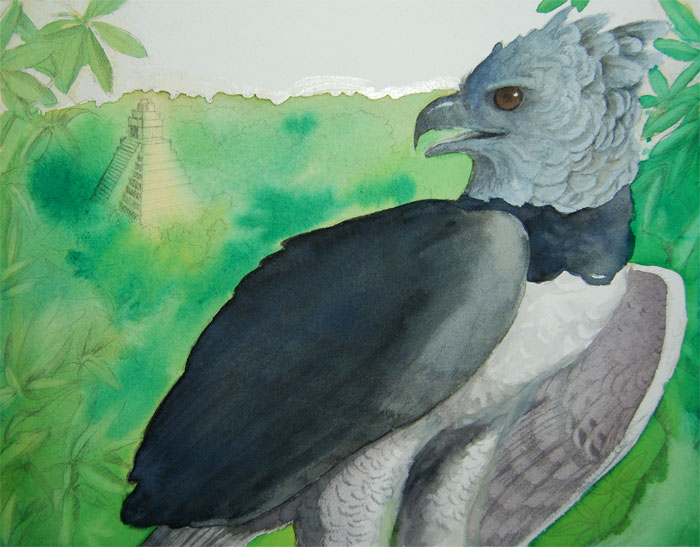
I did the first few washes for the harpy eagle painting. I'm not sure how I feel about the challenge of so much jungle green, but I think it will work out nicely. In particular, I'm having fun with the eagle's crest feathers.


My next painting is going to most likely be the saker falcon, looking at its relationship with Middle Eastern falconers. During my research, I found a video of a saker hunting a small (baby?) gazelle (or other small species of deer), which was quite surprising. I never thought a falcon capable of taking down such prey. The video is here if you're interested.

Of course, the inspiration to paint falcons hit, so I decided to do a study on saker markings. They seem to be a varied bunch, especially in the markings on the head. It appears that most have plain brown backs without barring.


The sketch:


The initial background wash:

Harpy Eagle Sketches

Now that the barn owl is finished, I've gone full speed ahead on my next thesis painting, which is the harpy eagle. Harpy eagles throughout time have been seen as birds of power in Central and South America. Even today, the Baniwa People in the Northwest Amazon forests recognize Kamathawa, a harpy eagle deity.


Here are my initial thumbnails. You can see the rather boring compositions at the top that always come out until my brain gets warmed up and starts coming up with something better.


I decided on the bottom right sketch (of course it would be the last thumbnail I do! Just proof that you can never always go with your first idea), and fixed it up. After studying photos of harpy eagles a bit more, I came to realize that due to their rounded wings (similar to those of an accipiter, required as they hunt through dense forest), you don't see the primaries poking out from under the secondaries. It does look a bit strange at first, but it makes sense - harpy eagles don't have the long 'fingertips' of other eagles. Harpies also have a bit of a protrusion above their eye, just as accipiters do to protect their eyes from branches and leaves as they zoom through dense trees.


The final graphite drawing on my stretched watercolor paper. I try to only put in important shading and markings (such as bars on the feathers) with graphite, and do the rest with watercolor. I fixed a few more anatomical bits. One of the wonderful advantages of doing three sets of drawings (thumbnails, final sketch, final drawing), is that you have three points at which to check your anatomy!

The branch the eagle is standing on is that of the Kapok, which was sacred to Mayans. In the middle ground you can also see one of the Tikal Towers in Guatemala. Harpy eagles are often seen in this area, and I wanted to connect both the ancient beliefs (Mayan) with present beliefs (Baniwa). Although these two groups of people did not live in exactly the same region, there are parallels between their cultures, and the harpy is a bird who ranges between Central and northern South America.

The sky on the left side will be heavy with rainclouds, where the sky on the right will be clear and blue. Sunlight will be streaming in from in front of the eagle, as one of the Baniwa beliefs is that the harpy eagle brings summer:

"Feathers obtained from Kamathawa aid the shaman in his ritual to clear the sky of clouds and make the summer come." --- Robin M. Wright, Guardians of the Cosmos: Baniwa Shamans and Prophets, Part I

Tuesday, February 24, 2009

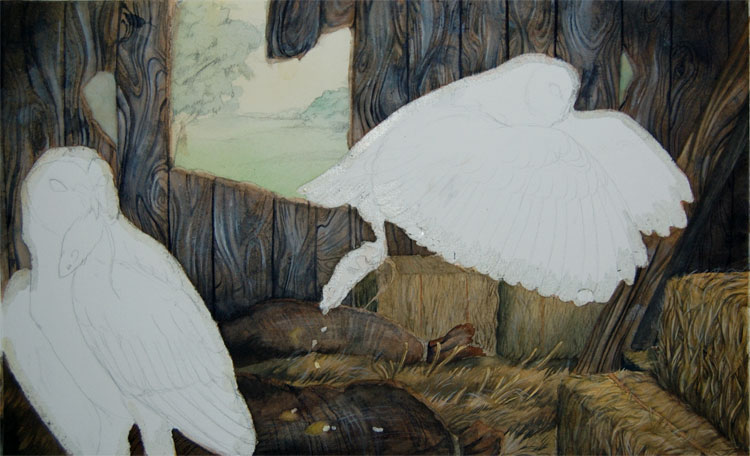
Barn Owl - Work in Progress 2

Well, I have the wood in the barn and hay bales almost finished. Now it's time to work on the owls.


The wood isn't nearly as 'whitewashed,' but due to the size of the piece (and it being mounted on a board), I had to photograph it instead of scan it. Thus, there are some strange light things going on. There's still much more work to be done, but I think it's coming along nicely.

Monday, February 16, 2009

Barn Owl - Study and Work in Progress

A study of a barn owl, just for plumage practice:


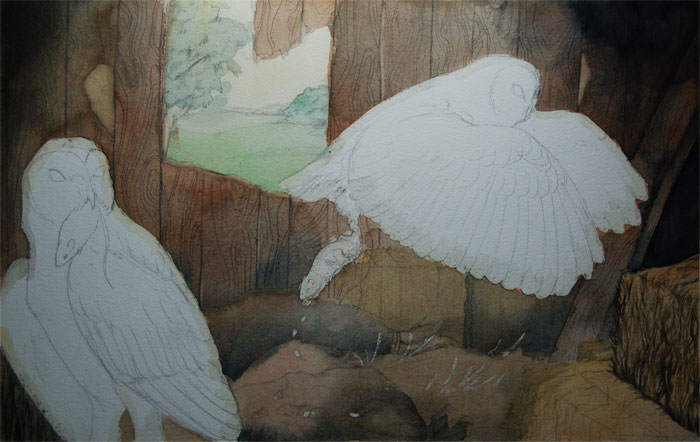
I started the background washes for the barn owls. At first, I had in my mind to paint it as a moonlit scene. The owls would be illuminated by white moonlight, as would part of the interior of the barn. However, I as started working on the study, I realized that in order to really bring out the rich colors of this owl, I should place it in daylight. I thought the hazy, yet yellow light of sunrise would work well. It's even more fitting, since barn owls hunt at dawn, as well as at sunset and midnight.


There will be much more detail, but for now, I am establishing tones based on the light and its source. The owls are also masked with masking fluid, so I don't have to worry about the dark background washes interfering with their lighter tones.