Saturday, May 9, 2009

Peregrine Falcon Thesis Painting Progress 2

Apologies for the lack of updates lately, however for the past week I've been concentrating on the writing portion of my thesis so that I would have a first draft done in time for editing. With that sent off, I've continued work on the painting of the peregrine falcon as used in falconry in the United States.

I am well aware that the peregrine is used worldwide in falconry, and not only in the United States. However, the purpose of this painting is not to exclude any region, but rather to focus on falconry in a specific area of the world, and I chose a bird that I feel represents a widely-used longwing species in the U.S.

It's only fair to point out the efforts of falconers and a variety of societies in the United States for peregrine falcon reintroduction after the widespread damage done by the pesticide DDT in the mid-20th century. The Peregrine Fund, which was started in 1970, was one of the foremost organizations in the United States to rebuild peregrine populations nationwide. To this day it remains an active force in raptor conservation. Other organizations which focus on raptor conservation include the North American Falconer's Association and a number of individual rehabilitation and education centers.

According to Candace Savage in her book Peregrine Falcons, the peregrine falcon population in the west coast region of the United States went from over 1,400 pairs in the 1940s to just over 100 pairs in the mid-1970s (an in-detail graph of worldwide populations exists on page 54, in case you have the book). In the late 1980s, the population on the west coast rose to just over 400 pairs. Today, the population of the peregrine falcon is doing well, thanks to the banning of DDT and these conservation efforts.

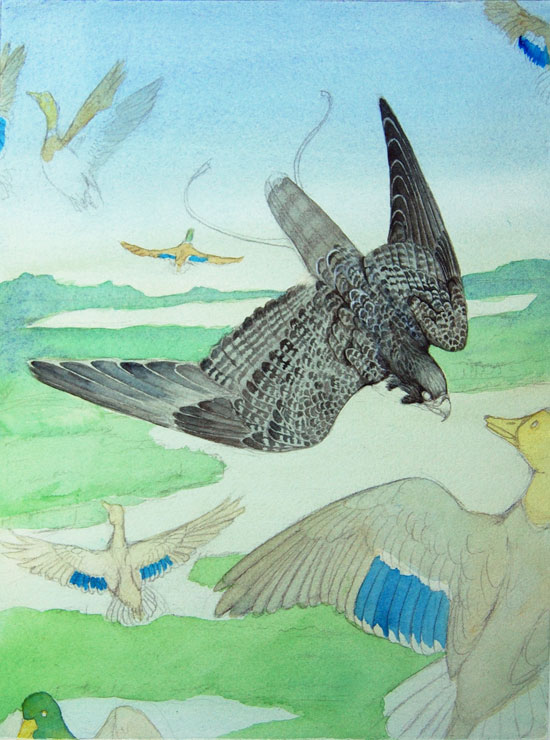
That said, here is the painting in progress:

And a detail of the falcon so far:
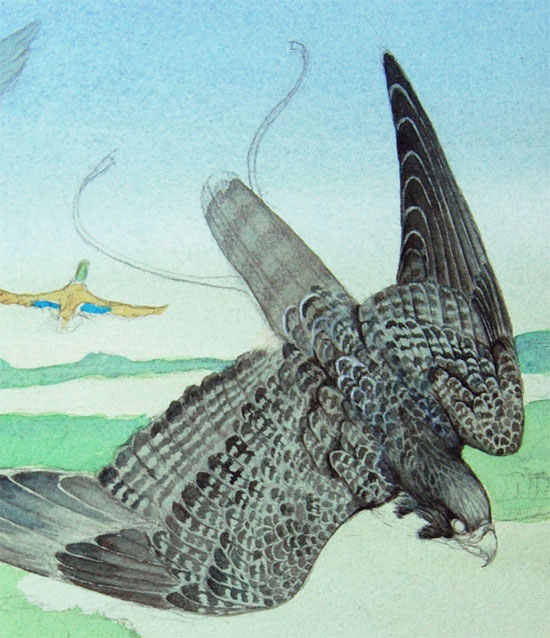

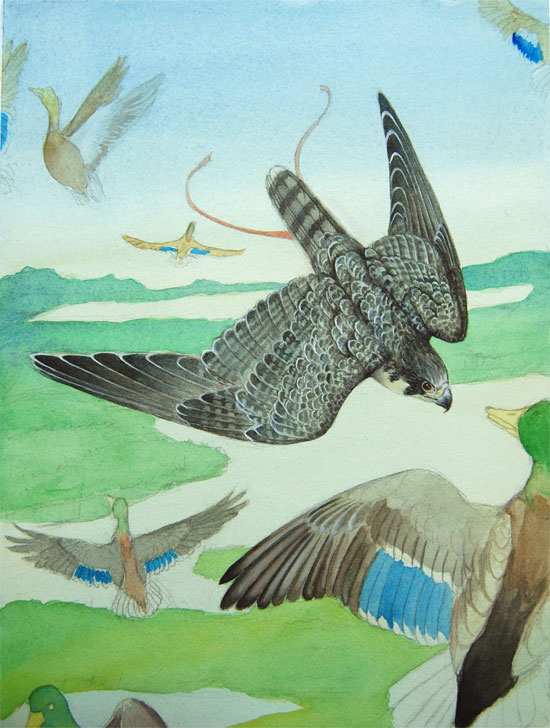
There peregrine falcon is also known as the 'duck hawk,' for what should be an apparent reason. When choosing a duck species, I wanted to show mallards since that is one of the most well-recognized duck species in the United States. While I know the jesses probably wouldn't be flying so wildly as that, I wanted to put a bit of movement behind the stiff, angular falcon to compliment the curving ducks.

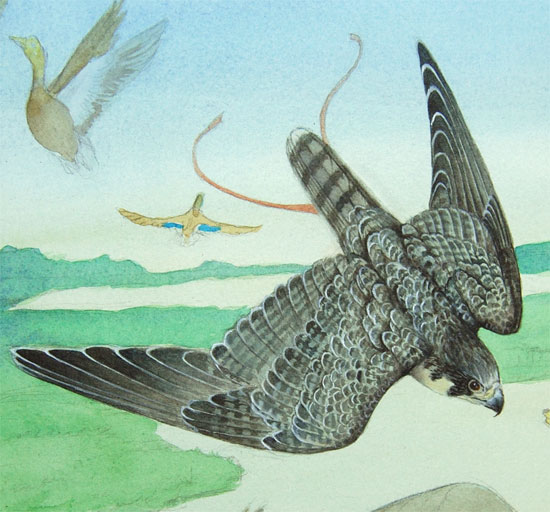
The markings of peregrines are so beautiful, and while challenging to paint, it's rewarding when it starts to come out right.

UPDATE May 9, 2009 2:48 AM Here's a bit more progress:

Detail of the falcon:
Thursday, April 30, 2009

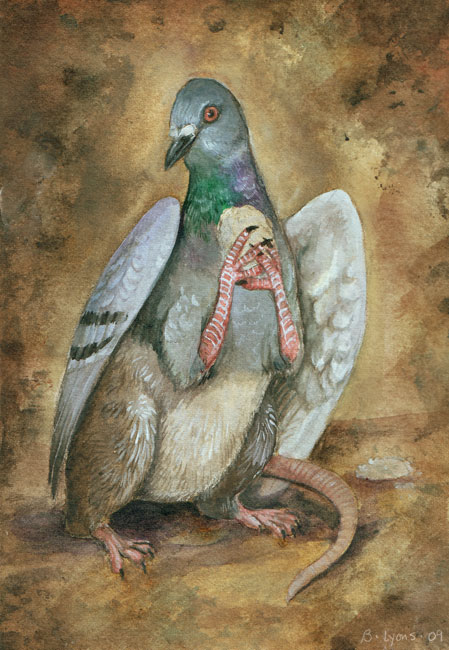
Rat with Wings

Well, I don't have a new thesis painting progress to show, but I do have a silly little painting I did really quick to include with some art for a fantasy art show.

It's a pigeon/rat gryphon, and he really loves his bread.

A lot.

Enjoy.


Watercolor and white gouache on cold-press watercolor paper, 5X7 inches.

Tuesday, April 28, 2009

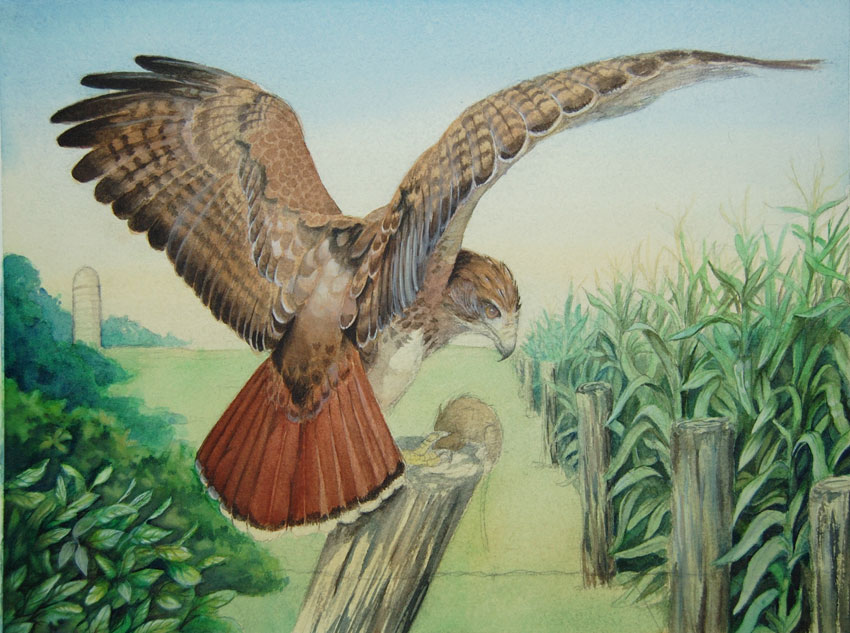
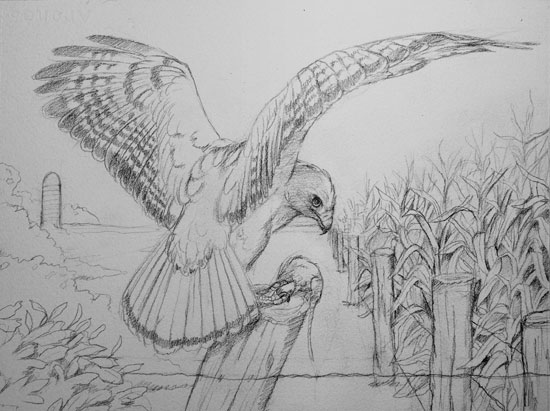
Red-tailed hawk progress 3

This is probably the last progress shot before I finish the painting. Here's a bit more detail on the hawk and the greenery. I always have trouble using green in bushes and trees without making it look flat and too monochromatic.


I've used a lot less white gouache on this than with the previous painting (the saker falcon painting), and I'm happy - I prefer the transparency of watercolor to opaque pigment.

Sunday, April 26, 2009

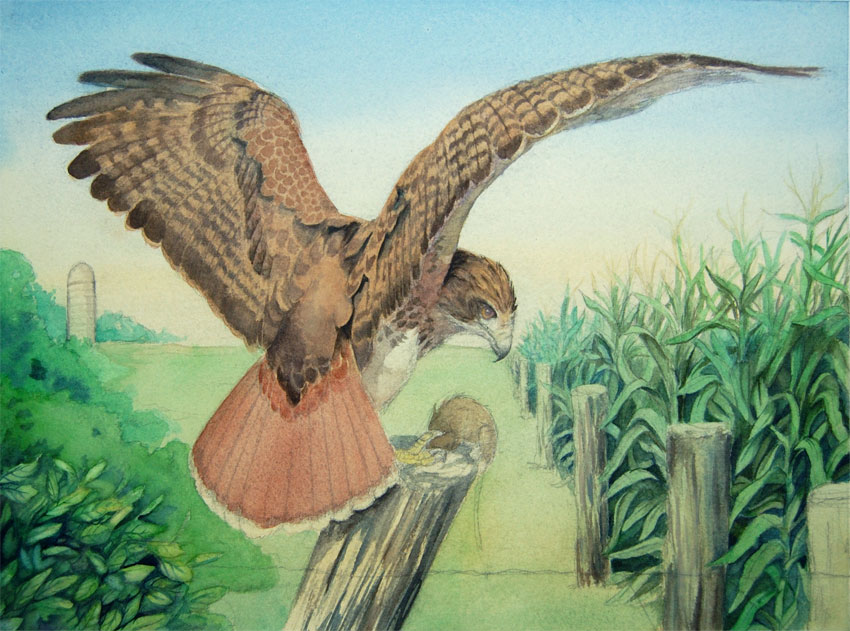
Red-tailed hawk progress 2

Another progress shot of the red-tailed hawk thesis painting. As before, I got carried away and forgot to take a progress shot, so it's much farther along for a 'second progress shot' than I'd planned!


The corn was surprisingly fun to paint. In addition to exploring each bird's plumage with watercolor, I'm also learning about landscapes and plants through each of these paintings. I've never painted corn before, and now I found a reason to!

For the sky, the detail-obsessed part of me is going, it's too simple! You need to add clouds! It needs to have more color! More more more!. Yet another, more (dare I say it) sophisticated part of me is saying, the sky is fine! Look at morning skies in real life. Often they are cloudless and simple. I think I shall keep the sky as it is. I think with all the detail in the hawk and plants, there needs to be some simplicity in the background.

I also wondered if I've been relying too heavily on the white gouache, so for this painting, you'll notice that there's no gouache in it yet. I think I will use it for the white bases of the feathers on the back, and perhaps for some detail on the leaves.

Tuesday, April 21, 2009

Double Feature - Peregrine and Red-Tail Progress

Now that the end of the quarter is within view, it's time to really get things rolling towards completion of the thesis. So far, I have four out of ten paintings done, and a good deal of writing down for the written portion.

Oddly enough, I work better (and faster) if I'm working on two paintings rather than just one. Aside from practical purposes (working on the second painting while a watercolor wash dries on the first, for example), I find working on two different pieces keeps my mind sharp and discourages wandering off to become caught up in distractions (such as sitting mindlessly in front of the computer).

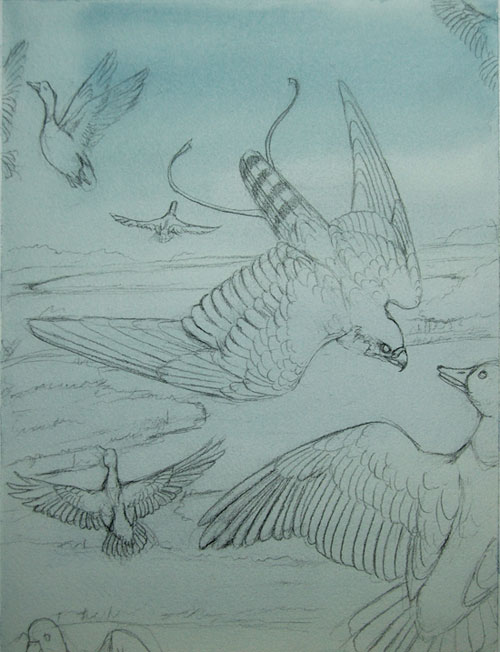
Here is the graphite progress on the peregrine falcon painting. The blue tint is the initial wash.


I will admit - I'm making the peregrine painting extra special because it's my favorite of the birds. Aside from my shameless bias, I wanted to show the action that I feel the peregrine represents, both in the wild and in falconry. Part of my inspiration was renewed when I spoke with Stephen Hein, artist and director at The Center for Wildlife Education and the Lamar Q Ball, Jr. Raptor Center at Georgia Southern University in Statesboro, Georgia during a recent visit. He described a scene I've read about many times but never heard spoken by a falconer - he told about how he waited for his falcon to stoop, so high in the air, he couldn't see her. Then, that sound - the sound often described as 'tearing canvas' in the books - and she shot down into view in pursuit. Hearing of such an experience made my heart race again with newfound inspiration.

When I think of falcons I think streamlined, sharp, pointed. The shape of the stoop, even of the moment right as the bird is about to strike her prey, is sharp and angled. The peregrine is designed perfectly for speed, and in this painting, I wanted to show that, in contrast with the rounded, confused ducks.

The second painting is going to explore at the red-tailed hawk, and its passive role in human culture as 'vermin control.' Like the barn owl, red-tailed hawks actually benefit farmers by hunting the rodents that damage crops. Unfortunately, throughout history, this widespread hawk has been the victim of shooting, from farmers who incorrectly see them as 'chicken hawks.' In fact, the hawks that are most likely to take a shot at poultry are the accipiters - more specifically, the two larger species, the Coopers Hawk and the Northern Goshawk. Buteos like the red-tailed hawk are primarily rodent hunters.


I'm looking forward to working on all those beautiful feathers on the back, wings, and tail!

Tuesday, April 14, 2009

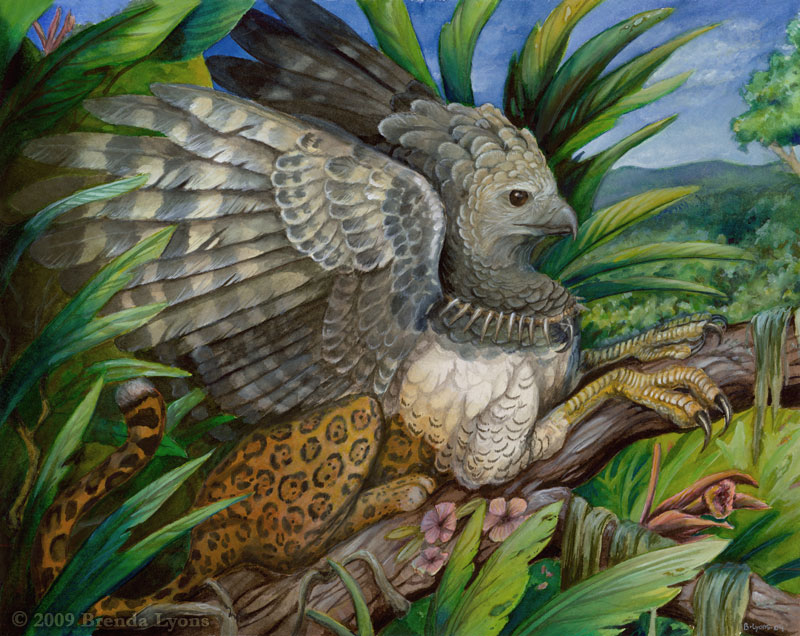
Jaguar Kamathawa

Although this blog is meant primarily to show the process of my thesis paintings, I felt this one piece of personal work was relevant enough, in a way, to post here.


As mentioned before when posting the works in progress of the harpy eagle painting, I mentioned Kamathawa, the divine harpy eagle of Baniwa belief. Kamathawa is thought to bring summer and end the rains, and its feathers are considered to have power to those who possess them. According to Guardians of the Cosmos: Baniwa Shamans and Prophets by Robin M. Wright, "its predatory quality is enhanced by the title "Jaguar" Kamathawa."

This, of course, is not a portrayal of the Kamathawa of the Baniwa people, but rather an inspiration from their legends and descriptions. And, of course, the term "Jaguar Kamathawa" served as a springboard for inspiration for this particular gryphon.

This watercolor and white gouache painting is 11X14 inches on Arches cold-press watercolor paper.

Saturday, April 4, 2009

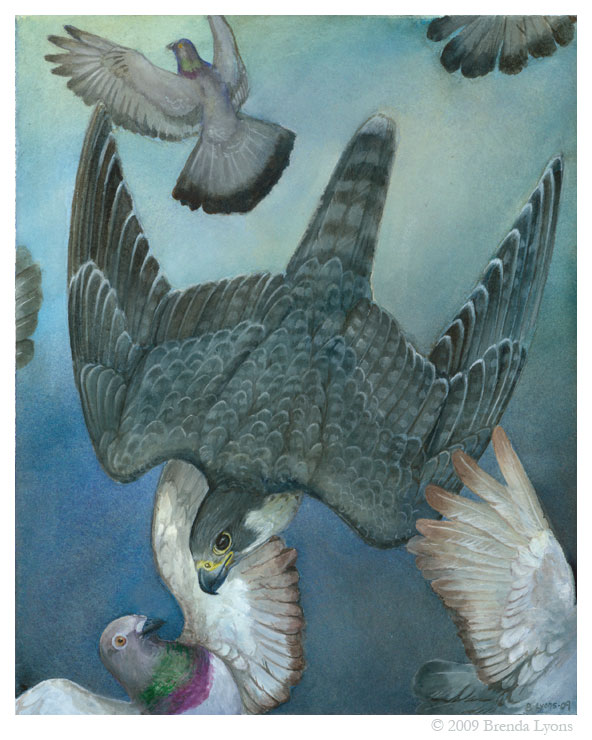
Peregrine Falcon Study

I just couldn't wait anymore; I had to paint a peregrine!


This was an study for plumage and form, and also it ended up being a study for rock doves, too. I love pigeons. They're so beautiful and so fun to paint! This is watercolor and white gouache on watercolor paper, 8X10 inches.

The saker falcon painting is done, and I'll be sure to post it up here once the thesis is complete. Now it's time to set up the show!