Showing posts with label falcons. Show all posts

Wednesday, March 23, 2011

Share One Planet Sketches

I was recommended by a friend to send an invitation request to the Share One Planet competition. It is an invitation-only digital art competition featuring a number of animals of concern. I am happy to say that I was accepted and given an invitation, and I decided this would be an excellent reason to try more digital art.


There are 5 categories (technically 10, but each category has a digital painting and digital sculpture category within it). The one I chose after doing a few sketches was "Mother's Love." The first set of sketches show ideas in other categories, such as 'portrait' and 'predator and prey.'

Thinking about what a 'mother's love' is in the animal kingdom truly is about protection. Most humans have the luxury of protection by the law and society's standards, but in nature, the only law is that of survival.

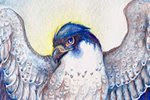
The peregrine falcon is truly a remarkable creature. It is the fastest creature on the planet, yet is relatively small compared to other raptors. Young falcons are especially at risk of predation by larger raptors, particularly by golden eagles. Despite the size difference, parent falcons have been known to attack and kill golden eagles in defense of their young.


In this drawing I am trying to capture the fierce protection of the mother. Leaving the chicks to fly is risky, but the falcon's strength is in the sky...and all she needs is a bit of height and the advantage is hers.

Monday, February 22, 2010

Conjure

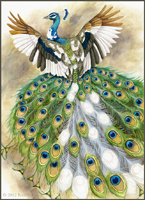
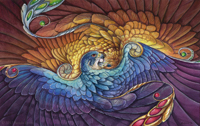
As sometimes happens, I decided on a different title for this painting about halfway through. "Conjure" seemed to fit better for the purpose...


I've been having a bit of an inspiration block, partially due to the inability to find the right paper for watercolor. I know, it sounds odd for someone who has been using watercolor for years to suddenly have a 'paper crisis' but as you evolve as an artist, often your technique calls for different media.

This painting represents my muse in a way. I realize I've probably broken a hundred different 'rules' of color, but this piece was meant to relax and 'reset'. I went from a bundle of nerves to relaxed as soon as paint hit paper with this one. Sometimes it's good to just get all that color frustration out!

Saturday, February 20, 2010

Sun Dreams - WIP

I'm going back to an old method for watercolor. I also decided to do this on some 'lesser quality watercolor paper' (i.e. "not Arches") and was a bit taken aback to find that I was able to use this paper (Windsor and Newton Watercolor Paper) better than the Arches cold-press I usually use. While the Arches is great for holding onto vibrant color, that's also a bit of a drawback - it holds onto pigment and doesn't let go. Ever. I find I work best if I'm lifting up pigment, and it's near impossible to do that with Arches.


More spirit falcons! Yay!

I also got a temporary replacement monitor. It's a 19 inch CRT, but the colors are spot-on. I spent about 3 days off and on adjusting the brightness, contrast, and gamma until it was just right. One of the drawbacks of using a monitor that's dying to the point where you can't adjust it anymore is you get used to poor brightness and inaccurate color. I knew something was off, but I didn't realize how 'monitor blind' I had been until I got this new one! Once I'm able to save up enough, I plan on buying a good LCD monitor. While this CRT is good and accurate, it's a huge electricity hog and the natural refresh flicker (60 Hz) is just noticeable enough to annoy me. Still, it's better than what I had before!

Sunday, January 3, 2010

Sepia watercolor practice, two watercolor paintings

From most recent to oldest, here are two paintings and a watercolor study I've completed within the past month:

Sky Painter
Watercolor on hot press arches, 4X9 inches


This painting was partially inspired by a quote I read on Helen Macdonald's blog, Fretmarks. The entire blog is quite interesting, though the post linked above, containing the quote, is one of my favorites.

"And then I thought, decidedly, yes. Goshawks are water. Falcons are air and hot stone. Goshawks are water and wood."

The next painting will be the same dimensions, but will feature the goshawk, with water and wood.


Ambition's Flaw
Watercolor and white gouache on cold-press Arches, 8X11 inches


Looking back on the palettes I commonly use, purple and pink are two colors that are definitely lacking. This seemed like as good an excuse as any to experiment with those poor, neglected colors.


Harris and Girl
Sepia watercolor on cold-press arches, about 9X12 inches


Using only one color is a good way to focus on control of the medium and light and dark without having to concentrate on colors. This was an exercise mainly in value in watercolor.

Wednesday, October 7, 2009

Falcon With Blue Eyes - Watercolor Painting


Three figures stand before a cracked vision and acknowledge an identity based in the simplest of elements.

The sun
The moon
The wind and forest.
A kingdom of clouds and their gift of rain


And yet they seek simple grains of sand buried beneath piles of gaudy jewels. All they want is to feel the earth again.
----------

Well, this took a bit of a different turn from when I started it. I literally had a moment where I was about to start painting and said, "well this is meant to be a bit of a self portrait, isn't it?" And so it was, and my handling of the colors changed as a result.

Of course, it's not a literal, physical self-portrait. I don't really look like that, but I incorporated portions of my anatomy (hair and eye color, primarily). There's a lot of symbolism in this important to me; the falcon should be the most obvious.

Watercolor and a tiny bit of colored pencil on cold press Arches watercolor paper, 9X12 inches.

Monday, October 5, 2009

Falcon With Blue Eyes - Work in Progress 3

One more work in progress shot before I probably finish it. I'm rather pleased with how this is turning out. I'm using a bit of a different painting technique...and I got a sharp new #4 round.


It feels good to do some watercolor after being stuck in digital land with this client project...

Falcon With Blue Eyes - Work in Progress 2

Here's a work in progress of the painting I'm working on. I finally found a title after it became apparent this was becoming a metaphorical self-portrait.


Per the suggestion of one of my professors at SCAD-Atlanta (Rick), I moved the ear straighter as it looked like it was sliding off her head before. I also need to move it back a bit. I also changed the bird closest to the face to a falcon since it was necessary with the change in meaning of this painting.

Saturday, May 9, 2009

Peregrine Falcon - Homestretch!

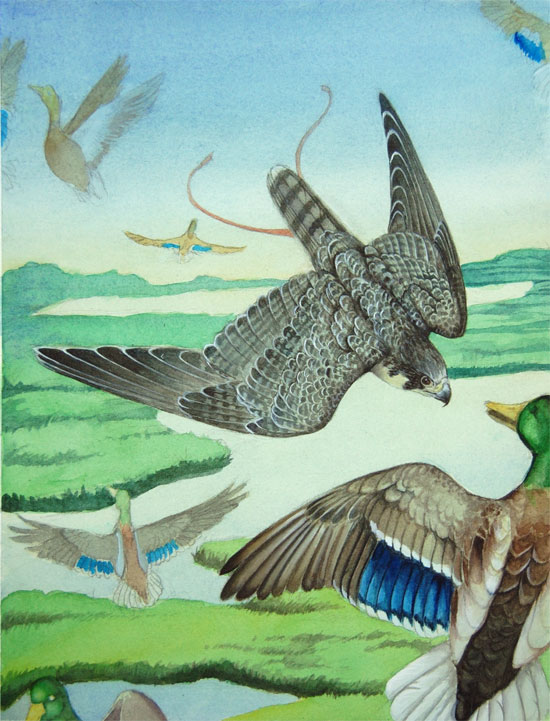
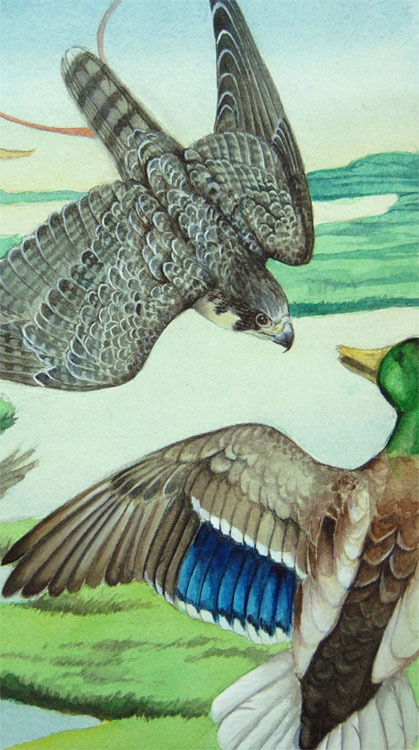
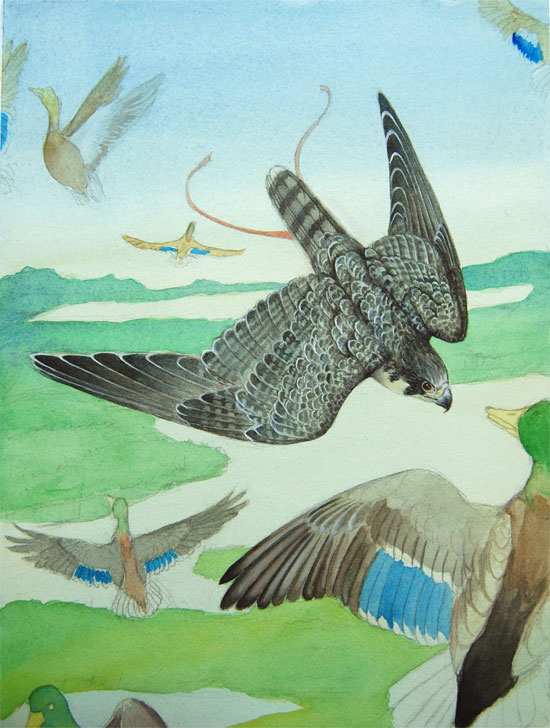
I'm close to finishing the peregrine falcon thesis painting, so here is a progress shot so far. I've never really painted ducks before, so this proved to be an excellent excuse to study mallard plumage and try my hand at painting one. They're such lovely birds with such interesting plumage!


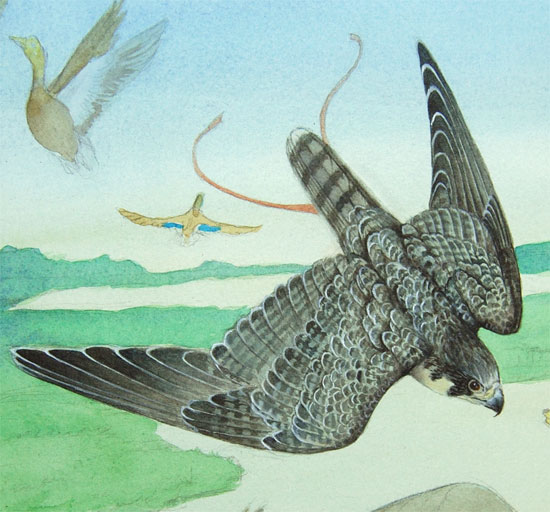
And a detail of the peregrine and duck:


I will have my thesis done by May 30th, so on that date, I will start to post the finished thesis paintings here.

Peregrine Falcon Thesis Painting Progress 2

Apologies for the lack of updates lately, however for the past week I've been concentrating on the writing portion of my thesis so that I would have a first draft done in time for editing. With that sent off, I've continued work on the painting of the peregrine falcon as used in falconry in the United States.

I am well aware that the peregrine is used worldwide in falconry, and not only in the United States. However, the purpose of this painting is not to exclude any region, but rather to focus on falconry in a specific area of the world, and I chose a bird that I feel represents a widely-used longwing species in the U.S.

It's only fair to point out the efforts of falconers and a variety of societies in the United States for peregrine falcon reintroduction after the widespread damage done by the pesticide DDT in the mid-20th century. The Peregrine Fund, which was started in 1970, was one of the foremost organizations in the United States to rebuild peregrine populations nationwide. To this day it remains an active force in raptor conservation. Other organizations which focus on raptor conservation include the North American Falconer's Association and a number of individual rehabilitation and education centers.

According to Candace Savage in her book Peregrine Falcons, the peregrine falcon population in the west coast region of the United States went from over 1,400 pairs in the 1940s to just over 100 pairs in the mid-1970s (an in-detail graph of worldwide populations exists on page 54, in case you have the book). In the late 1980s, the population on the west coast rose to just over 400 pairs. Today, the population of the peregrine falcon is doing well, thanks to the banning of DDT and these conservation efforts.

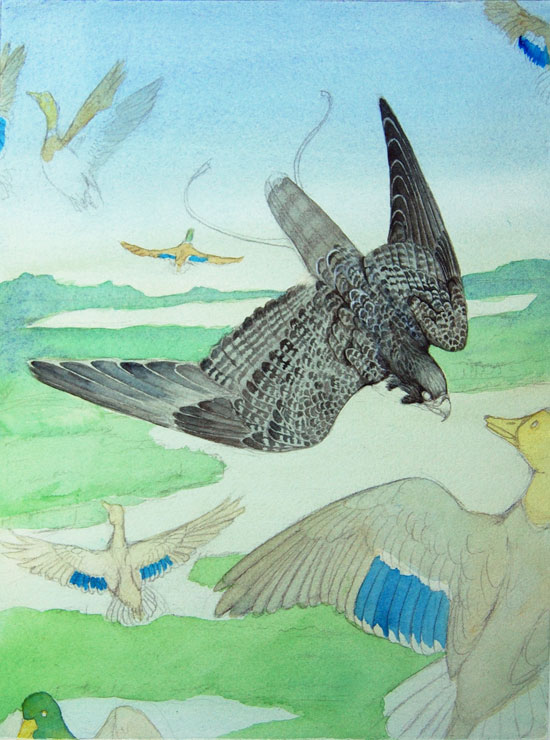
That said, here is the painting in progress:


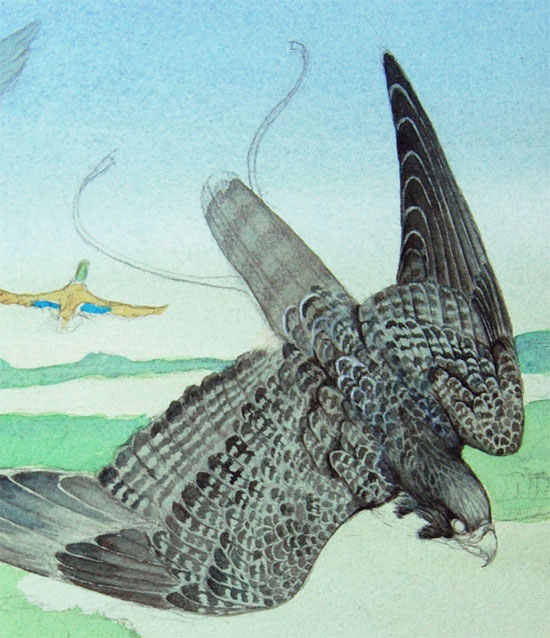
And a detail of the falcon so far:


There peregrine falcon is also known as the 'duck hawk,' for what should be an apparent reason. When choosing a duck species, I wanted to show mallards since that is one of the most well-recognized duck species in the United States. While I know the jesses probably wouldn't be flying so wildly as that, I wanted to put a bit of movement behind the stiff, angular falcon to compliment the curving ducks.

The markings of peregrines are so beautiful, and while challenging to paint, it's rewarding when it starts to come out right.

UPDATE May 9, 2009 2:48 AM Here's a bit more progress:


Detail of the falcon:

Tuesday, April 21, 2009

Double Feature - Peregrine and Red-Tail Progress

Now that the end of the quarter is within view, it's time to really get things rolling towards completion of the thesis. So far, I have four out of ten paintings done, and a good deal of writing down for the written portion.

Oddly enough, I work better (and faster) if I'm working on two paintings rather than just one. Aside from practical purposes (working on the second painting while a watercolor wash dries on the first, for example), I find working on two different pieces keeps my mind sharp and discourages wandering off to become caught up in distractions (such as sitting mindlessly in front of the computer).

Here is the graphite progress on the peregrine falcon painting. The blue tint is the initial wash.
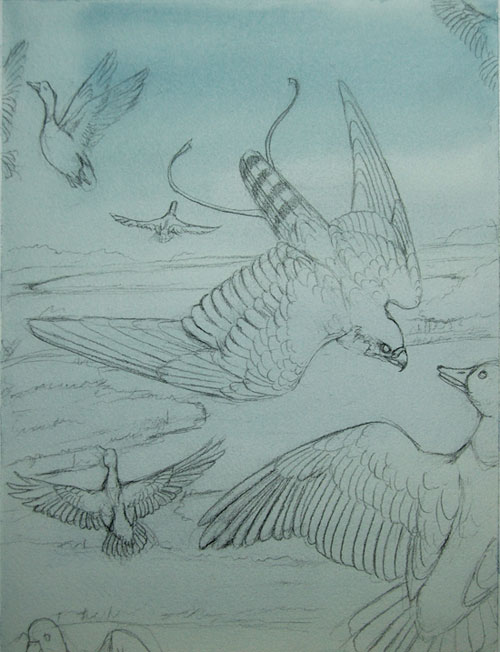


I will admit - I'm making the peregrine painting extra special because it's my favorite of the birds. Aside from my shameless bias, I wanted to show the action that I feel the peregrine represents, both in the wild and in falconry. Part of my inspiration was renewed when I spoke with Stephen Hein, artist and director at The Center for Wildlife Education and the Lamar Q Ball, Jr. Raptor Center at Georgia Southern University in Statesboro, Georgia during a recent visit. He described a scene I've read about many times but never heard spoken by a falconer - he told about how he waited for his falcon to stoop, so high in the air, he couldn't see her. Then, that sound - the sound often described as 'tearing canvas' in the books - and she shot down into view in pursuit. Hearing of such an experience made my heart race again with newfound inspiration.

When I think of falcons I think streamlined, sharp, pointed. The shape of the stoop, even of the moment right as the bird is about to strike her prey, is sharp and angled. The peregrine is designed perfectly for speed, and in this painting, I wanted to show that, in contrast with the rounded, confused ducks.

The second painting is going to explore at the red-tailed hawk, and its passive role in human culture as 'vermin control.' Like the barn owl, red-tailed hawks actually benefit farmers by hunting the rodents that damage crops. Unfortunately, throughout history, this widespread hawk has been the victim of shooting, from farmers who incorrectly see them as 'chicken hawks.' In fact, the hawks that are most likely to take a shot at poultry are the accipiters - more specifically, the two larger species, the Coopers Hawk and the Northern Goshawk. Buteos like the red-tailed hawk are primarily rodent hunters.
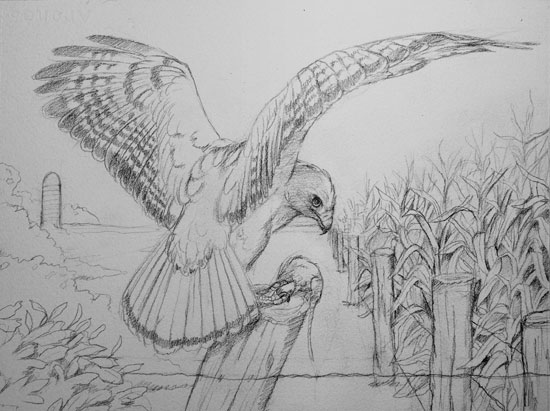


I'm looking forward to working on all those beautiful feathers on the back, wings, and tail!

Saturday, April 4, 2009

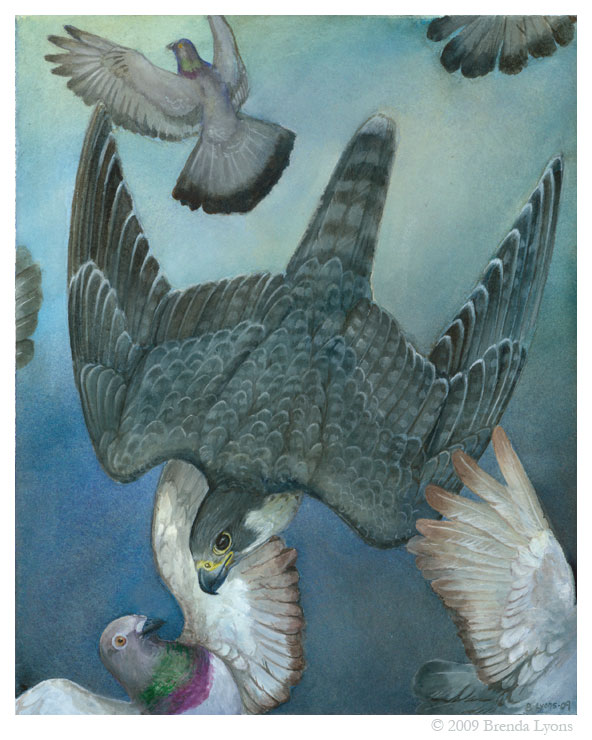
Peregrine Falcon Study

I just couldn't wait anymore; I had to paint a peregrine!


This was an study for plumage and form, and also it ended up being a study for rock doves, too. I love pigeons. They're so beautiful and so fun to paint! This is watercolor and white gouache on watercolor paper, 8X10 inches.

The saker falcon painting is done, and I'll be sure to post it up here once the thesis is complete. Now it's time to set up the show!

Tuesday, March 31, 2009

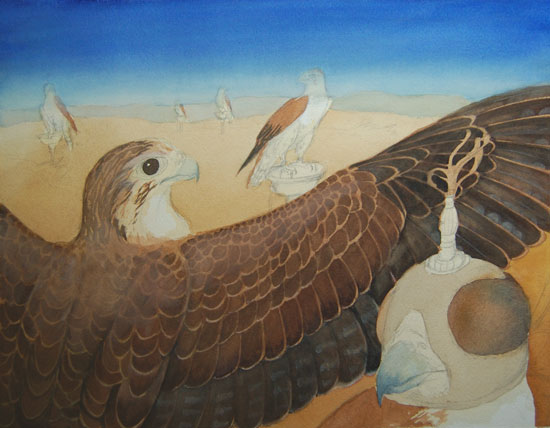
Saker Falcon Painting Progress 3

This is probably the last progress shot before I finish the painting. One a painting reaches this stage, I generally work on it steadily until I finish.


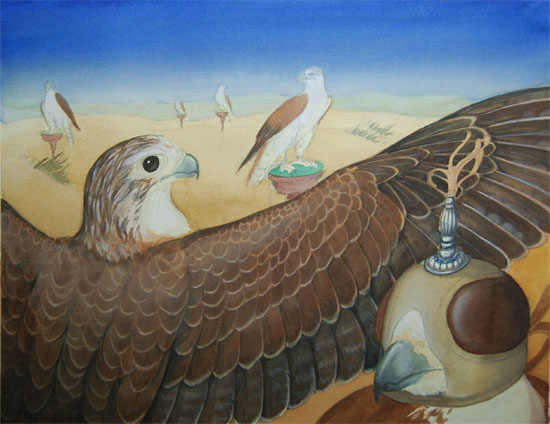
I'm having a lot of fun with the hood. The silver adornment is especially challenging, since I get to experiment with a reflective, shiny surface.

Monday, March 30, 2009

Saker Falcon Painting Progress 2

I should have posted this last night, but I got caught up on other things and it slipped my mind. Here is last night's progress of the saker falcon painting:


Right now I'm trying to get detail in while making sure the colors move around the composition. This shouldn't be a problem, since the falcons' beaks are bluish, so there won't be an overwhelming expanse of blue at the top third of the piece without any blue anywhere else.

Despite being a forest girl inside and out, I can still appreciate the dramatic beauty of the desert. There aren't many places you get such vibrant color, and the burning orange of the sand with the striking blue of a desert sky definitely serves for an interesting color palette.

Saturday, March 7, 2009

Harpy Eagle Progress and Saker Falcon Studies

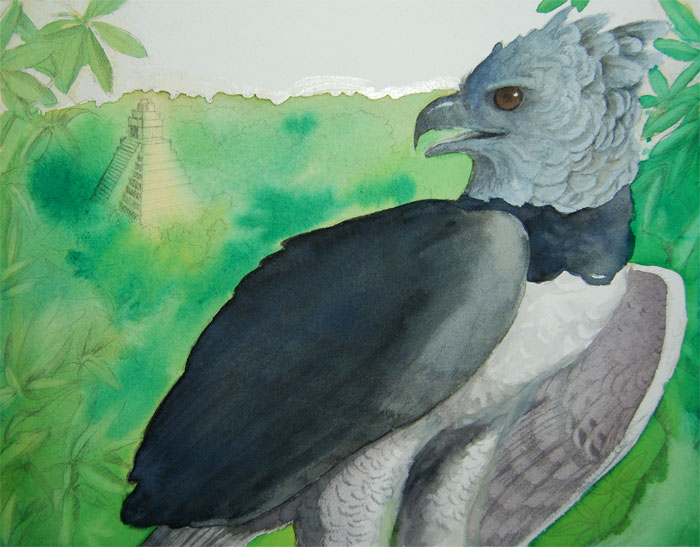
I did the first few washes for the harpy eagle painting. I'm not sure how I feel about the challenge of so much jungle green, but I think it will work out nicely. In particular, I'm having fun with the eagle's crest feathers.


My next painting is going to most likely be the saker falcon, looking at its relationship with Middle Eastern falconers. During my research, I found a video of a saker hunting a small (baby?) gazelle (or other small species of deer), which was quite surprising. I never thought a falcon capable of taking down such prey. The video is here if you're interested.

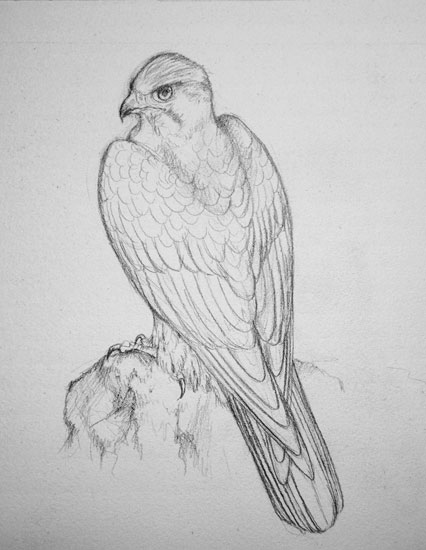
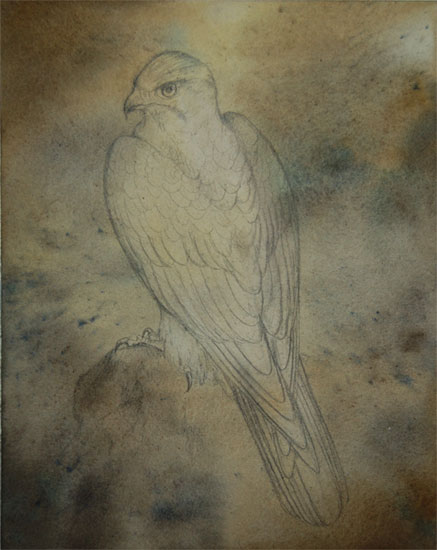
Of course, the inspiration to paint falcons hit, so I decided to do a study on saker markings. They seem to be a varied bunch, especially in the markings on the head. It appears that most have plain brown backs without barring.


The sketch:


The initial background wash: